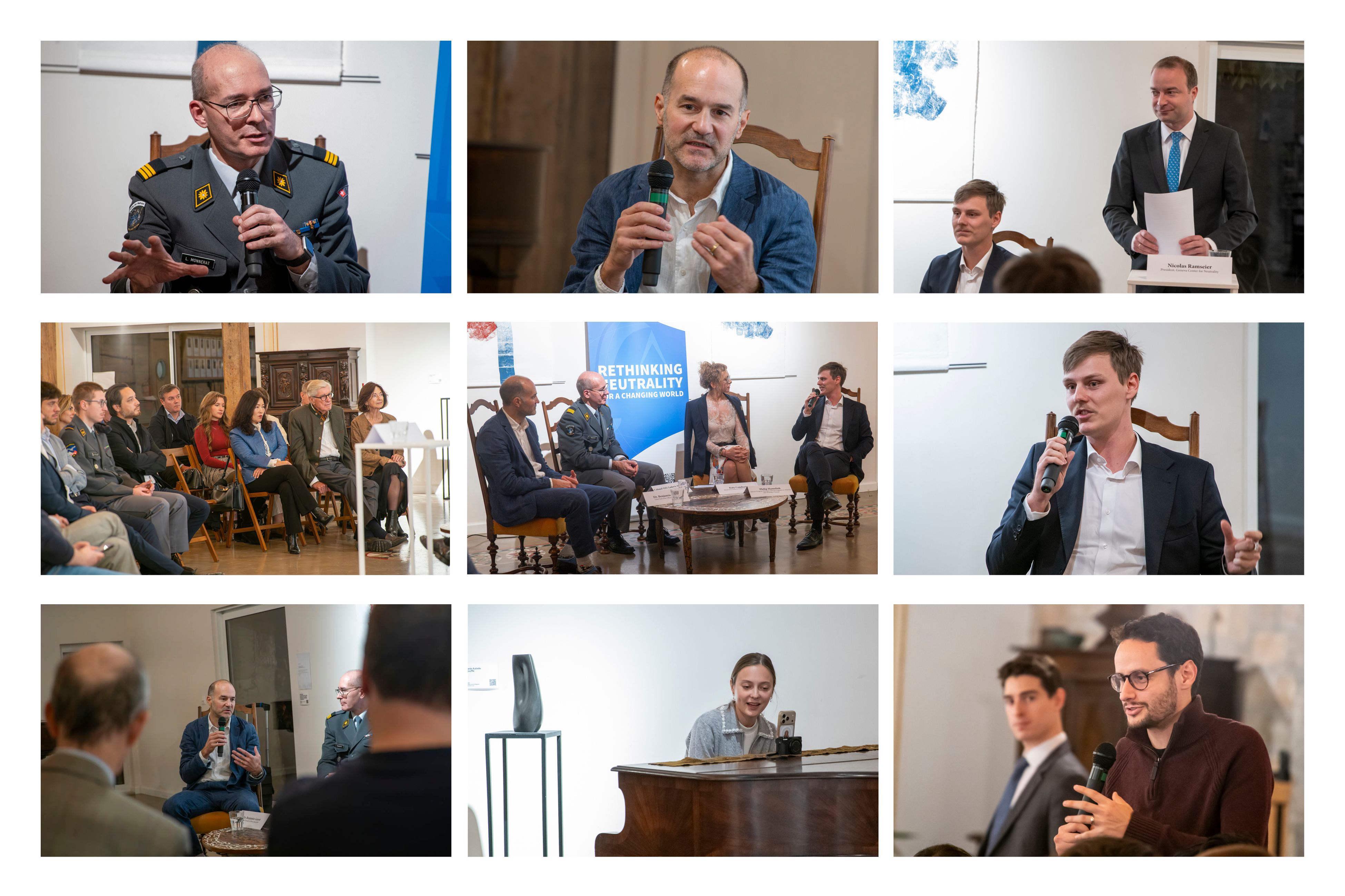
At a Geneva conference, military, legal and industry experts explored the choices that will shape security far beyond Earth orbit. On 20 October 2026, the Geneva Center for Neutrality brought together Colonel (GS) Ludovic Monnerat, Commander of the Swiss Space Command; Dr Benjamin Guyot, co-founder and CEO of Spacetalk, whose professional experience includes fifteen years at the European Space Agency, and Philip Hamelink, Interim Program Manager of WISeSat (WISeKey group) to the discussion on “Outer Space and the Future of Global Stability: Can Space Remain a Neutral Domain for All Humanity?”. It was hosted at the Ferme de Marsillon.
Giving neutrality a practical role
Nicolas Ramseier, Co-founder and President of the Geneva Center for Neutrality, delivered the opening keynote and began with two definitions. Neutrality, in its legal sense, is the status defined by the Hague Conventions of 1907: a state that takes no part in a conflict, treats the belligerents impartially and keeps them off its territory. It is, he observed, a law of soil. Outer space, by contrast, is the only domain of human activity with no agreed frontier, and the Outer Space Treaty of 1967 forbids any state to appropriate it. Set side by side, the two definitions expose the problem that ran through the entire evening: neutrality is a law of territory, and space is a domain where territory is forbidden. Space is nonetheless a neutrality question in three ways, he argued: dependence, dual use and the private actor. Communications, navigation and financial timing connect national life to systems operated across borders. Some serve civilian and military users simultaneously. Others belong to companies whose decisions affect governments as well as customers.
For Nicolas Ramseier, these dependencies invite a fresh examination of what neutrality requires in practice. How can a state preserve freedom of action if essential services depend on decisions taken elsewhere? And what happens to civilian users when infrastructure also serving armed forces comes under pressure? “Almost every one is dual-use,” he said of today’s satellites: “the satellite that guides an ambulance guides a missile. Space is no longer a frontier. It is the plumbing of the modern economy, plumbing that belongs to no one and that anyone can break.”
His keynote proposed a direction: “So if neutrality is to mean anything beyond Earth, it has to stop being a line and become a function.” Neutral space as a territory, he concluded, is a utopia; neutral actors and neutral infrastructure in space are not. The Centre, he added, does not pretend to have the answer: its position is a starting point, and the evening was there to test it. The idea gave the evening its intellectual starting point. Neutrality could have a role in the design of services, channels of communication and infrastructure that different parties are willing to use. Its value would have to be demonstrated through reliability and trust. He left the panel with one question: looking back from 2040, which decision taken today will have determined whether outer space became a battlefield, or humanity’s last neutral territory?
A new space race is underway
Colonel (GS) Monnerat Commander of the Swiss Space Command outlined the geological man of the outer space today: “The geopolitical situation in space is characterized by the overwhelming dominance of the United States of America, which alone launches half of the world’s rockets and operates the majority of satellites - primarily thanks to one company, SpaceX, which has a considerable lead over all other space industry players in terms of rockets and satellites.”
The figures he presented gave that assessment its scale: approximately 10,700 operational Starlink satellites out of more than 16,000 in orbit.
“A new space race is underway, unfolding at an ever-increasing pace”, - Commander of the Swiss Space Command is convinced. In his account, China is investing heavily across the spectrum of space applications, seeking parity with the United States. The speed of deployment, however, depends on launch technology and capacity. Russia, while conducting substantially fewer launches, retains significant capabilities, including those relevant to military competition.
Colonel (GS) Monnerat also described a recent close approach by a Russian satellite to a commercial radar-imaging satellite. The example illustrated a feature of orbital security that is easy to miss from the ground: movement itself can communicate strategic intent. His emphasis was on the ability to establish what is happening. Better observation can help distinguish a technical problem from an unusual manoeuvre or a potentially threatening action. Greater transparency can reduce uncertainty and make responsible behaviour easier to assess.
That is where specialist knowledge becomes a diplomatic resource. Dialogue is more useful when the parties have a clearer understanding of the events they are discussing.
Europe’s challenge and Switzerland’s response
For Europe, Colonel (GS) Monnerat identified a gap between the scale of planned satellite systems and the means available to deploy them. Constellations require launchers, industrial capacity and systems that can work together. His conclusion was direct: “We therefore find ourselves in a difficult situation, with a huge gap between ambitions and available resources, even as space becomes increasingly important for societies, economies, and armed forces.”
Switzerland’s response, as he described it, combines national expertise with cooperation. Swiss Space Command is developing capabilities in monitoring the space environment, intelligence, satellite communications, positioning, navigation and timing, alongside defensive measures. Those capabilities can also support civilian authorities. He presented the project ALPSTAR launched within ESA in cooperation with the civilian colleagues of the Swiss Space Office as an approach to sharing resources while preserving national control. Participating countries can connect capabilities without giving up authority over their own assets.
Two satellites, one collision course: who makes the first move?
Dr Benjamin Guyot, co-founder and CEO of Spacetalk brought the discussion to a moment when that question becomes immediate. Two satellites risk colliding. One must move. Which one? A manoeuvre uses fuel, creates work and may affect a satellite’s operational lifespan. The decision has a cost. An organisation empowered to allocate that cost would have considerable influence over the operators involved.
Dr. Benjamin Guyot’s distinction was therefore important: providing a trusted channel for exchanging information is different from directing another operator’s actions. A neutral intermediary could help competing actors communicate their positions and intentions, including when political relations make direct cooperation difficult. Such a service would meet a common need without having to resolve every disagreement between its users.
The consequences of failure can spread far beyond the original encounter. Dr. Benjamin Guyot explained how collision debris can cause further collisions, putting other spacecraft at risk. He also drew attention to the ambiguity of new technologies: equipment capable of servicing a satellite or removing debris may also be capable of interfering with an operational spacecraft.
Intent, communication and trust become inseparable from engineering. His argument favoured practical progress. A comprehensive international agreement on space governance and exploitation is necessary, but difficult to reach at present. A practical tool to address immediate problems may therefore be the most efficient way forward.
The Moon: “first come, first served”?
Dr. Benjamin Guyot extended that reasoning to the Moon, where the US-led Artemis framework and the China - Russia-led International Lunar Research Station initiative raise questions about how different activities will coexist. He pointed to a potential tension between legal principles and physical realities. If early arrivals occupy particularly valuable locations, what access remains for those who follow? His concern was that a “first come, first served” logic, already in place for Earth orbits, will naturally entrench practical advantages for most advanced space nations before common coordination arrangements are in place.
For Geneva, this opens a demanding opportunity. The city brings together diplomacy, the International Telecommunication Union and access to scientific and industrial expertise. Yet Dr. Benjamin Guyot stressed that a Swiss address alone cannot guarantee acceptance as an intermediary. Trust to its neutrality must be earned from the actors concerned.
Your data is encrypted. But who holds the keys?
Philip Hamelink, Interim Program Manager of WISeSat (WiseKey group) examined independence from inside the communications system. There are different layers of sovereignty, he explained: access to launch services, control over manufacturing and supply chains, and authority over data. Countries may depend on others in one area while strengthening their position in another.
WISeSat’s objective, in his account, is to provide resilient, secure communications. A country may have extensive mobile coverage and still face disruption if its terrestrial infrastructure fails. Satellite connectivity offers another route when that route becomes essential. But connectivity is only the beginning. Sensitive information may be encrypted; the next question is who controls the keys.
Philip Hamelink emphasised the root of trust, the technical foundation used to authenticate systems and information. Meaningful control requires clarity about who can authorise access, verify authenticity and protect data. He also drew an important boundary: a government’s need to secure its communications does not confer unrestricted access to private companies’ information.
Then came the financial reality. Sovereignty costs money. Smaller states must decide what they need to control directly and what they can build together. Shared investment can make capabilities affordable that would otherwise remain out of reach.
Europe’s space ambitions: from launchers to AI
Questions from the audience heated up even more the discussion. Could increased defence investment strengthen Europe’s space industry? How could sensitive capabilities be shared? Would new launchers have enough customers?
Dr. Benjamin Guyot added an economic dimension to Colonel (GS) Monnerat’s assessment: Europe needs sustained demand as well as technology. Frequent launches help support the economics of reusable systems. Industry needs a credible view of the activities and markets Europe intends to develop over the coming decades.
The debate also widened to artificial intelligence. Colonel (GS) Monnerat described the convergence of AI, space and robotics as a significant force in future competition. Dr. Benjamin Guyot considered how AI could improve traffic coordination, while noting the persistent difficulty posed by old orbital objects unable to communicate.
A role for Geneva
Across these exchanges Katy Cojuhari, co-founder and head of international cooperation at the GCN, moderated a discussion that moved from the balance of global power to a deceptively practical question: when something goes wrong above Earth, who can still make cooperation work? The speakers brought different disciplines to a shared problem. Colonel (GS) Monnerat emphasized observation, capability and operational credibility. Dr. Benjamin Guyot explored the conditions under which rivals could coordinate. Philip Hamelink examined the technical and financial foundations of independence.
Together, their arguments gave substance to the keynote’s question about neutrality as a function. “We need definitely a way to enable the dialogue and neutrality is, I believe, what is needed to enable the dialogue, whatever happens, in order to act as a valid intermediary between various actors”, - Dr. Benjamin Guyot is convinced.
That function might be a channel through which operators exchange manoeuvre information. It might be a shared observation capability that leaves participants in control of their assets. It might be secure communications whose users retain authority over their data.
The evening closed with a charming final touch: Victoria Ramseier sang “Fly Me to the Moon” and “Rocket Man”, accompanying herself on the piano, offering another way of imagining the space.
The policy question remained: looking back from 2040, which choices made today will have mattered most? Perhaps some will be quieter than a launch. An agreed procedure. A trusted intermediary. A warning received in time - and believed. And perhaps Geneva will become the place where a new agreement on outer space takes shape, opening a new chapter in international cooperation beyond Earth.