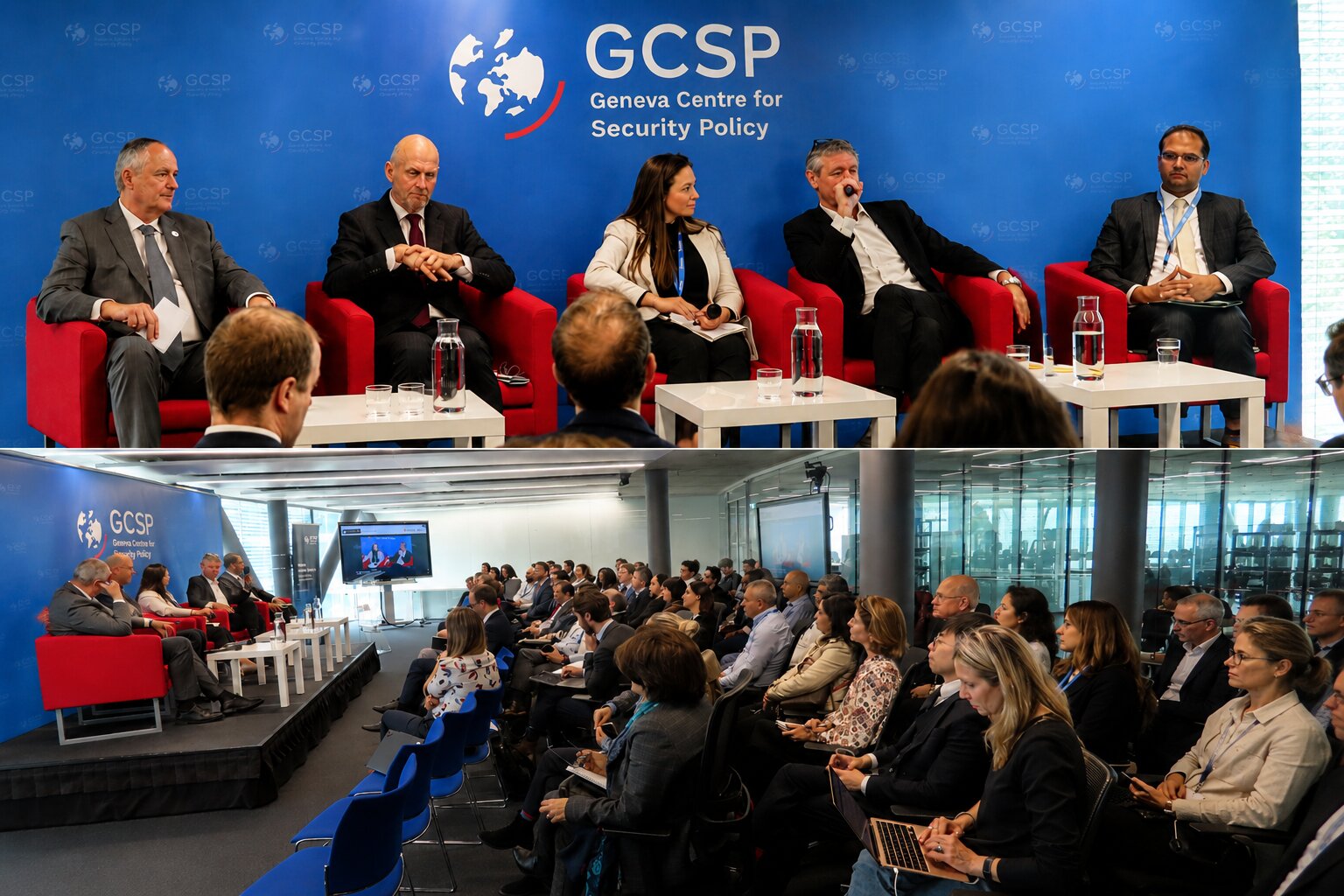
On 6 May, at Maison de la Paix, the Geneva Centre for Security Policy (GCSP), in partnership with the Geneva Center for Neutrality (GCN), convened a conference on “Mediation Synergies and Complex Global Conflicts.” The event brought together diplomats, mediation practitioners and humanitarian actors to reflect on how mediation can remain effective in a world marked by geopolitical rivalry, active hostilities, fragmented authority and declining trust in international norms.
The conference opened with a keynote address by Ambassador Thomas Greminger, followed by a panel discussion featuring Mr Jawad Ali, Deputy Permanent Representative of Pakistan to the United Nations Office at Geneva; Ambassador Jean-Daniel Ruch, Co-Founder of the Geneva Center for Neutrality; Ambassador Tormod Cappelen Endresen, Permanent Representative of Norway to the United Nations in Geneva; and Mr Alain Deletroz, Director General of Geneva Call. The discussion was moderated by Ms Seraina Eldada.
Diplomacy under pressure
In his opening remarks, Ambassador Thomas Greminger placed the discussion within the wider context of today’s volatile international environment. His intervention highlighted that mediation is increasingly taking place not in calm diplomatic settings, but alongside active hostilities, strategic rivalry and public escalation.
He drew attention to the Gulf and the Strait of Hormuz as examples of how localised tensions can quickly generate global consequences. Disruptions in such strategic corridors affect energy markets, supply chains, inflationary pressures and households far beyond the immediate region. From this perspective, mediation is no longer only a regional concern; it is a global necessity.
Ambassador Greminger also underlined Geneva’s enduring relevance as a place where difficult conversations can take place. Yet his remarks made clear that symbolism alone is not enough. Geneva’s value lies not only in its neutrality and convening power, but also in its ability to support discreet, patient and coordinated dialogue in situations where comprehensive political settlements remain difficult to achieve.
Mediation as an ecosystem
A central idea running through the conference was that contemporary mediation can no longer be understood as the work of a single actor operating alone. Complex conflicts require ecosystems of engagement, involving states, international organisations, regional actors, humanitarian organisations, civil society networks, religious leaders and informal dialogue platforms.
The discussion emphasised that the real challenge is not simply the presence of multiple actors, but the coordination of their efforts. When aligned, diverse actors can reinforce one another and create momentum. When uncoordinated, they risk duplication, fragmentation or competing initiatives.
This idea of mediation synergies shaped much of the conversation. Mediation today is not only about reaching an agreement at the negotiating table. It is also about sustaining the wider environment in which negotiation becomes possible: keeping channels open, building trust, reducing escalation and preserving space for future dialogue.
Pakistan’s approach: regional responsibility and peaceful settlement
Mr Jawad Ali presented Pakistan’s mediation outlook as one rooted in respect for international law, the United Nations Charter and the peaceful settlement of disputes. His remarks conveyed the idea that mediation is not an abstract diplomatic exercise, but a practical necessity for regions affected by long-standing conflict, insecurity and underdevelopment.
He stressed that Pakistan’s geography, relationships and regional experience shape its approach. As a country with close ties to key regional actors, Pakistan can contribute to dialogue by maintaining channels of communication and supporting de-escalation. Its approach is based on patience, discretion and the recognition that mediation must remain voluntary: mediators cannot impose political will, but they can help create the conditions in which parties may choose dialogue over confrontation.
Mr Ali also highlighted the importance of partnerships. In his view, middle powers and regional actors can play a constructive role by mobilising diplomatic support, encouraging restraint and keeping the door to dialogue open even when the political environment is difficult. His intervention also pointed to the need for greater mutual learning between mediators from different regions, including the Global North and Global South.
Norway’s approach: quiet diplomacy, persistence and inclusion
Ambassador Tormod Cappelen Endresen outlined the broad contours of Norway’s mediation practice, often associated with quiet diplomacy, long-term engagement and impartial facilitation. His remarks emphasised that mediation requires patience and continuity. Successful processes often unfold over years, and mediators must be prepared to remain engaged even when progress is slow or setbacks occur.
He conveyed the idea that Norway’s strength lies not in hard power, but in its ability to facilitate dialogue, build trust and work in partnership with others. He also stressed the importance of speaking with a wide range of actors, including those with whom one may profoundly disagree. Dialogue, in this view, does not confer legitimacy; rather, it is a necessary condition for achieving any meaningful outcome.
Ambassador Endresen also underlined inclusion as both a normative and practical requirement. Peace processes are more sustainable when they reflect the interests of the communities affected by conflict, including women, ethnic groups and other stakeholders often excluded from formal negotiations. His intervention further suggested that Western actors can remain credible mediators if they act consistently, minimise perceptions of double standards and work closely with partners from other regions.
Switzerland and neutrality: credibility beyond symbolism
Ambassador Jean-Daniel Ruch offered a nuanced reflection on Switzerland’s mediation identity. His remarks challenged the assumption that neutrality automatically produces effective mediation. Neutrality can be an asset, but it does not, by itself, create trust or credibility.
He emphasised that effective mediation depends on access, reliability, predictability and the confidence of the parties. Switzerland’s historical role, its diplomatic infrastructure and Geneva’s international ecosystem all contribute to its mediation profile. However, credibility must be constantly earned through professionalism, discretion and consistency.
Ambassador Ruch also drew attention to the distinction between neutrality and impartiality. In some conflicts, mediators may have interests or relationships with one side, but still be accepted if they are trusted, predictable and able to contribute meaningfully to de-escalation. His remarks suggested that, in today’s international environment, middle powers may have a particular role to play in defending international law and promoting stability.
A further idea in his intervention concerned the importance of avoiding double standards. Mediators who wish to remain credible must be rigorous in their respect for international law and must condemn violations consistently. Predictability, legal clarity and principled diplomacy are essential to maintaining trust.
Humanitarian diplomacy and engagement with armed actors
Mr Alain Deletroz brought the discussion from diplomatic settings to the realities of conflict zones. Representing Geneva Call, he focused on humanitarian diplomacy and engagement with armed groups. His remarks underlined that humanitarian actors do not conduct political mediation in the traditional sense, but their work can support broader conflict management by improving respect for international humanitarian law and protecting civilians.
He conveyed the importance of speaking with armed actors, including those labelled as terrorist organisations, without conferring political legitimacy on them. Such engagement is necessary to influence behaviour, reduce harm and improve the protection of civilians and detainees.
Mr Deletroz also highlighted the consequences of eroding respect for international law. When states themselves are perceived as disregarding international humanitarian law, it becomes far harder to persuade non-state armed actors to comply with it. This loss of credibility has direct consequences on the ground, where humanitarian actors must convince armed groups that rules still matter.
His intervention also pointed to the importance of local knowledge, cultural understanding and community engagement. Humanitarian diplomacy often depends on people who understand the language, values and social structures of the communities and armed actors involved. He also emphasised the role of religious leaders, women, families and local communities in influencing behaviour and supporting more humane outcomes.
Inclusion and legitimacy
One of the strongest themes of the conference was the need to broaden participation in mediation processes. Formal negotiations often focus on political or military actors, but sustainable peace requires the involvement of communities affected by conflict.
The discussion highlighted women’s participation not only as a matter of representation, but also as a source of influence, creativity and legitimacy. Women’s networks, community leaders and family structures can play important roles in shaping attitudes, encouraging restraint and supporting implementation.
Religious leaders were also identified as influential actors in many contexts. Their authority, reach and moral language can help translate humanitarian and peacebuilding messages into terms that resonate locally. The conference therefore stressed that effective mediation must connect formal diplomacy with the social realities of conflict-affected communities.
Geneva’s continuing role
The conference reaffirmed Geneva’s role as a major centre for dialogue, mediation support and humanitarian diplomacy. Geneva offers more than a neutral venue. It provides a dense ecosystem of international organisations, diplomatic missions, humanitarian actors, legal expertise, academic institutions and discreet convening spaces.
At the same time, the discussion made clear that Geneva must continue to adapt. Its relevance will depend on its ability to support not only formal negotiations, but also the broader mediation ecosystem: track two diplomacy, humanitarian engagement, regional initiatives, civil society participation and local ownership.
Geneva’s contribution lies in connecting these different levels of engagement and helping them reinforce, rather than dilute, one another.
Investing in mediation and prevention
The conference also addressed the question of resources. Mediation and prevention are often far less expensive than military action or post-conflict humanitarian response, yet they remain politically and financially under-supported.
The discussion suggested that one reason mediation may struggle to attract sustained investment is precisely because it is low-profile, long-term and relatively inexpensive. Unlike military spending, it does not generate large political or economic constituencies. Yet its potential value is immense: preventing conflict saves lives, reduces humanitarian suffering, limits displacement and protects regional and global stability.
A stronger recognition of the costs avoided through mediation and prevention would help place peace efforts higher on the international agenda.
Conclusion: building synergies for a fragmented world
The Geneva conference underscored that mediation remains essential, but it must adapt to a more complex world. Today’s conflicts are rarely resolved through one channel, one actor or one agreement. They require sustained engagement, coordinated partnerships and a willingness to work across political, cultural and institutional divides.
The speakers collectively pointed toward a mediation practice that is patient, principled and pragmatic. It must defend international law while remaining flexible in method. It must engage states and armed actors without legitimising violations. It must include communities, women, religious leaders and civil society alongside formal negotiators. And it must make better use of the complementary strengths of middle powers, humanitarian organisations and international platforms such as Geneva.
In a world where military power repeatedly shows its limits, mediation remains one of the most important tools for preventing escalation, preserving dialogue and keeping open the possibility of peace.