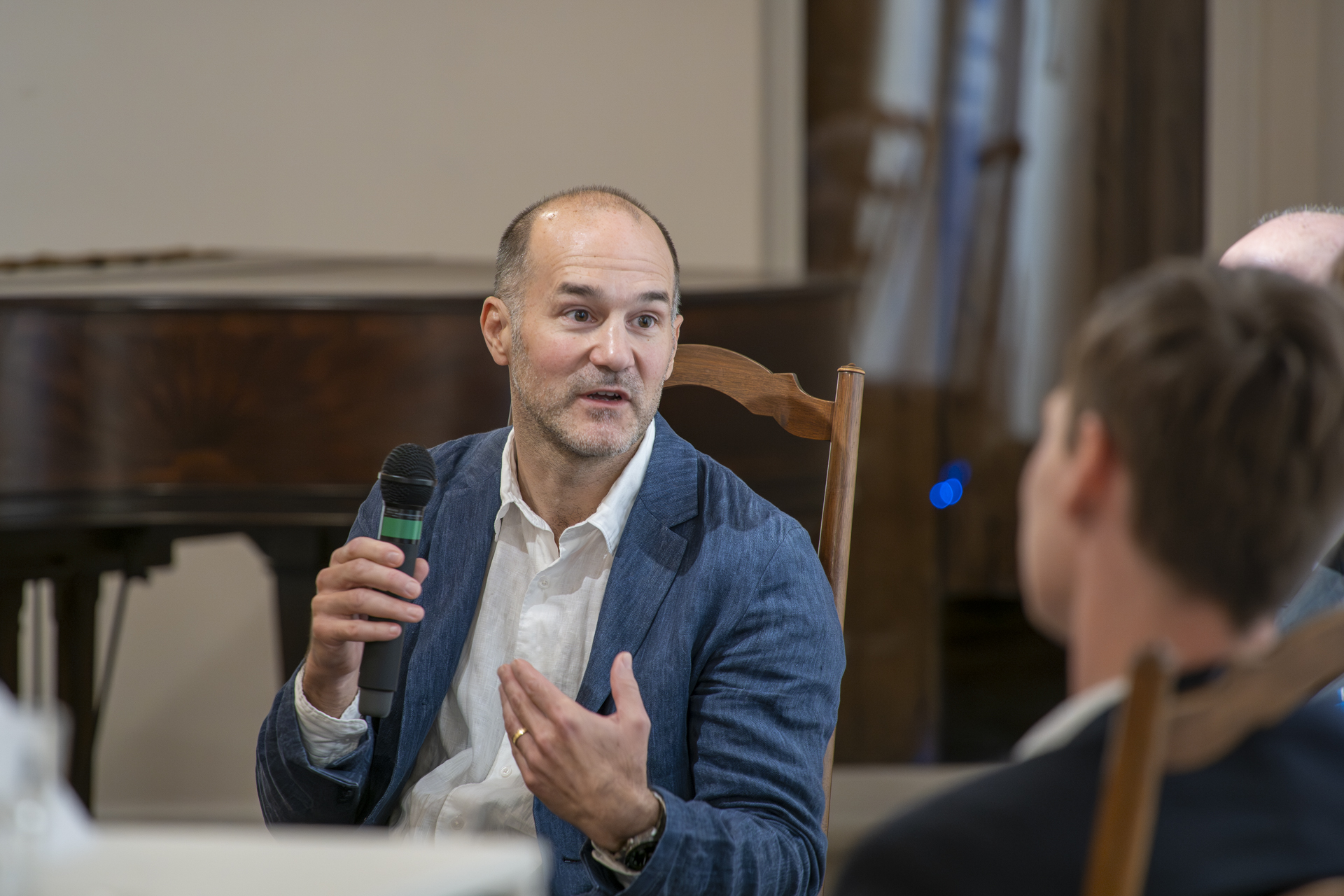
A new space race is gathering pace, accompanied by a gold rush for resources and commercial opportunities beyond Earth. Amid this growing competition, how can cooperation prevail - and what role could neutrality play? These practical dilemmas lay at the heart of the conference “Outer Space and the Future of Global Stability: Can Space Remain a Neutral Domain for All Humanity?”, organized by the Geneva Center for Neutrality on 20 October 2026 at Ferme de Marsillon in Geneva. The discussion brought together Colonel (GS) Ludovic Monnerat, Commander of Swiss Space Command, Swiss Armed Forces; Dr Benjamin Guyot, CEO of Spacetalk; Philip Hamelink of WISeSat (WISeKey group), and Nicolas Ramseier, President of the Geneva Center for Neutrality.
We present the full answers of Dr Benjamin Guyot, CEO and co-founder of Spacetalk, a Swiss company, which is developing a neutral platform for global space traffic coordination, to questions from the conference moderator and the audience.
Neutrality as a practical channel for dialogue
-Neutrality is facing a difficult test on Earth. Is there a place for it in space today? Do we need a new model, or perhaps a Geneva Convention, when the same satellite can serve military purposes and hospitals?
The situation in space is becoming difficult because misunderstandings could lead to an escalation of conflict. When applying the law, we need to look carefully at the facts and at what makes space distinctive. One object can affect all the others through the so-called Kessler syndrome: a collision creates debris, which causes further collisions, generating still more debris and potentially making an entire orbit unusable.
That could last for five years in the best case, or thousands of years in the worst. A single object can therefore damage many others. We all have a common interest in resolving difficult situations and avoiding escalation. We will also soon have in-orbit servicing, including space tugs that refuel satellites or remove debris. A vehicle with a robotic arm that can grasp another object could also be used as a weapon. These activities may therefore give rise to misunderstandings. We need governance, and a new treaty establishing effective governance would be welcome.
But if that is not possible, we should try to find practical solutions for the situations we are likely to face. Switzerland, as a neutral country, and neutrality more generally, could be particularly relevant here. A neutral intermediary can enable dialogue and the sharing of certain data between the main space powers. At present, actors are reluctant to cooperate. The landscape is complicated: it includes operators, agencies, defence organisations, scientists and private companies, some of which also provide services to armed forces, such as Earth observation imagery or telecommunications used by drones and weapons systems.
This creates a risk of conflict. In Geneva, UNIDIR also facilitates discussions among the main spacefaring nations about weapons in space. Weapons are not categorically prohibited there, although the placement of nuclear weapons and other weapons of mass destruction is prohibited by the Outer Space Treaty, but it would lead to an escalation of conflict in space. Disagreements about intentions and capabilities can also lead to conflict escalation in space. We therefore need a way to keep dialogue open and provide tools to support transparency.
Neutrality is, I believe, what is needed to enable dialogue, whatever happens, and to act as a credible intermediary between different actors. But when launching this company, I noticed that not all major space powers see Switzerland as fully neutral today. This is a central issue: a state can only act as a credible and efficient neutral intermediary if other countries recognize its neutrality. A unilateral declaration is not sufficient. Neutrality is further strained when a neutral country develops close economic ties with specific partners – as all countries inevitably do in a globally integrated world – because those ties can create conflicts of interest. A single neutral country therefore appears too weak to guarantee the stable operational neutrality that a space security system requires: continuous availability to all countries and operators, without discrimination. A space traffic coordination system operating from several neutral countries could therefore provide a more reliable foundation for non-discriminatory access and continuous availability, regardless of the geopolitical situation. It also depends on the technical scope of your activities—on what you actually do. Today, space traffic coordination is organized by the United States, China, Russia and Europe, but there is no adequate dialogue between competing space actors.
SpaceX, for example, cannot coordinate a manoeuvre with Chinese operators. When a collision risk is identified, an operator performs a manoeuvre, publishes it on a website and hopes that the other side reads the information. We need a way to exchange that data. But space traffic coordination involves different functions: sharing information about a planned manoeuvre, assessing where objects are, and deciding who should move. One operator may have to manoeuvre while another does not. Every manoeuvre has consequences in terms of impairment of strategic capabilities, workload, propellant consumption and cost.
An authority deciding who must manoeuvre would therefore have a considerable influence on a company’s viability. Many aspects of space traffic coordination require a neutral intermediary, but we need to focus on the minimum dialogue that can be provided to everyone. If the intermediary starts making subjective decisions about who should move, it risks losing its neutrality. Neutrality must be considered case by case, although we can establish general rules.
The coordination previously provided by the US military for much of the world has helped avoid many collisions. Today, however, there is no global system enabling coordination across scientific, military and commercial activities and between competing space powers. A neutral system could provide that channel of communication. It should concentrate on the minimum common denominator shared by all actors—dialogue—without becoming a traffic police officer telling them what to do. This would already provide a reliable place for data for all space traffic stakeholders and provide channels of communication at technical level to facilitate self-regulation.
Why Geneva and who should act?
- With competition for orbit and the Moon making it harder to change the rules later, why could Geneva be the best place for a new treaty, and which decision makers should it bring together?
Geneva already hosts the International Telecommunication Union (the ITU), which deals with the allocation of frequencies and orbital positions. It provides a technical forum in which private companies also participate. Its ability to bring public and private actors together is a major asset. We also need to include scientists and astronomers, whose observations are affected by satellites. Preserving dark and quiet skies is part of the discussion. Helping to bring order to space would be a natural role for Switzerland.
We like putting things in order—even our gardens at the weekend. But Switzerland also has a scientific heritage, particularly in astronomy, and the expertise needed for this work in terms of space activities and software engineering. We have space companies such as WISeSat, Beyond Gravity, APCO Technologies and Almatech, among many others. The capabilities are here. Switzerland may be a small country, but there are no small countries when we look at space: we all have access to it. What matters is expertise and financial capacity.
Nevertheless, being based in Switzerland or Geneva is not enough. It is a good starting point—a good CV—but we must keep questioning how we can remain neutral and provide such a system in a reliable manner despite geopolitical tensions. Geneva’s international role and Switzerland’s scientific and space capabilities are important assets.
Even if Geneva appears well suited to this role, we need to be self-critical about what has been missing and what could be missing in the future if we are to guarantee coordination and international dialogue under any circumstances. This may also require partnerships with other countries, such as Singapore for instance, and other neutral countries in the world. Such partners could also bring cultural perspectives distinct from Switzerland’s, since - whatever its own self-image - many countries see Switzerland as a Western country.
Europe needs demand as well as launchers
-How can Europe strengthen its position while access to launchers remains a bottleneck? Could increased European defence investment also support space capabilities, and what prospects do new European launch companies offer?
Increasing defense investments is naturally a way to also invest in space capacities considering the dual use of space, but it is not the only way. What we need in Europe is to create demand for space activities. Within ESA, we have struggled to make launch services economically viable. The United States has faced the same challenge. Musk developed a business model in which launching at such high cadence changes the economics: reusability becomes viable and worthwhile. In Europe, we are still launching only eight or nine times a year, so the scale is entirely different. We need to launch more, but that means creating demand. In the United States, an entrepreneur has driven that process.
Europe does not have the same approach to entrepreneurship. Demand is usually created by the public sector through projects. At the very least, we need a vision of the space economy we want to develop over the next ten, twenty and fifty years. We need to say what share of our economy we want to see in space over that period, so the European space actors know which space capacity to develop and which objectives to pursue. We have launchers intended to guarantee independent access to space, such as Ariane and Vega, but their economic viability remains a problem.
There is hope that the new micro launchers being developed in Europe—around five—will respond to the needs of this new space economy. But while we are developing systems, part of the demand is still missing.
The danger of a first come first served Moon
- How is Switzerland approaching the management of resources on the Moon, given the activities led by China and the United States?
The Outer Space Treaty of 1967 also covers activities on the Moon, particularly through the principle of non-appropriation. There is also the Moon Agreement, which the main space powers, including China, Russia and the United States, have not signed or ratified. The Outer Space Treaty does not foresee the possibility to exploit resources of the Moon, which is allowed by the Moon Agreement. There is no agreed governance framework organizing activities between the two competing groups seeking to establish a lunar base: the International Lunar Research Station initiative, led by China and Russia, and the Artemis programme, led by the United States. These initiatives bring together partner countries and private actors.
One disagreement concerns resource exploitation. Artemis foresees that possibility, whereas it is not explicitly mentioned in the ILRS agreement, whose declared objectives are more scientific. The danger is that the “first come, first served” logic followed in Earth orbit—where an operator can retain a position because it arrived first—is extended to the Moon. A race to occupy lunar locations and exploit its resources could prevent others from benefiting from activities there, leading to a form of appropriation that would contradict the Outer Space Treaty.
AI, orbital traffic and international law
- What role will artificial intelligence play in space, and how should it be regulated? How does international law apply to ballistic missiles passing through outer space?
Artificial intelligence will probably revolutionize space traffic by improving coordination. But space has a particular difficulty: very old objects are still orbiting Earth and they will keep doing so as long as we do not have capacities to remove debris. It is as if the first cars ever built were still circulating on Swiss roads. We hope that, in future, most satellites will carry equipment that makes them detectable, but having all space objects flying with the latest technology will take decades. But older objects cannot provide such signals. Until they are removed by space tugs, they will remain a particular problem.
It is only by feeding AI systems with reliable and complete data that we can support efficient collision avoidance systems.
Space resources also play a central role in the development of new technologies. For instance, helium-3 on the Moon, can provide energy and support the cooling of quantum computing and AI.
For what concerns ballistic missiles, there is no territorial sovereignty in outer space preventing such missile to be used, but the law of armed conflict and international humanitarian law still apply.
A ballistic missile attack against a space object would therefore most likely constitute an act of war in terms of international law. We should also remember that launchers and ballistic missiles use similar technologies. Ballistic missiles pass through space quite often, but this does not raise the same question of territorial sovereignty.