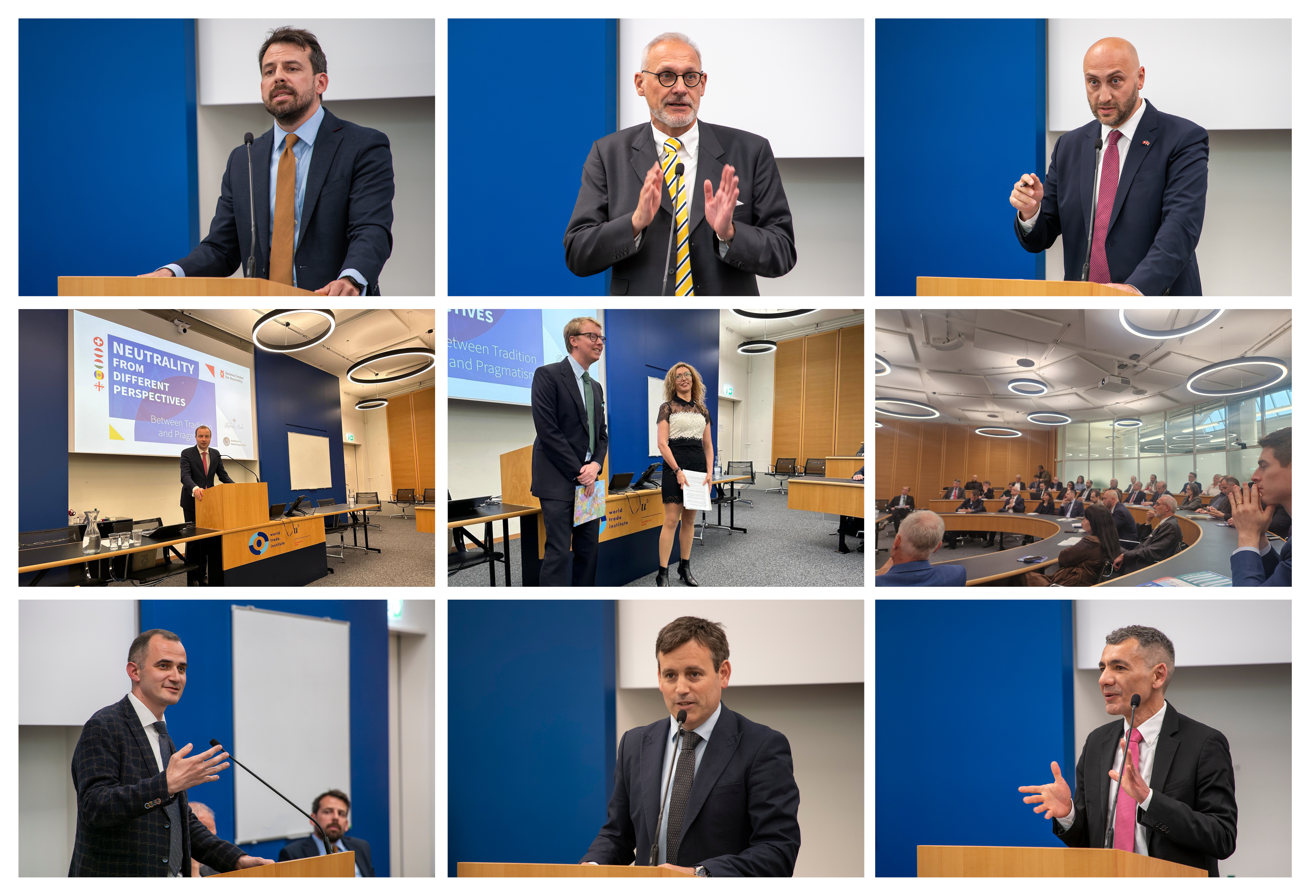
By 6 p.m., the spring air above the old streets of Bern was still cool, but inside the halls of the World Trade Institute at the University of Bern, the atmosphere had already turned electric. Academics opened notebooks. Military attaches exchanged polite nods. Ambassadors and diplomats from Europe, USA, China, Canada, the Middle East, and beyond adjusted ties and leaned toward one another in hushed conversation. And hanging over the room was one deceptively simple question to analyze: What does neutrality actually mean in this historical period, right now, in 2026?
That was the premise of the international high-level conference “Neutrality from Different Perspectives: Between Tradition and Pragmatism,” organized by the Geneva Center for Neutrality together with the Institute for Global Negotiation on May 6 in Bern. The event gathered officials and academics from Switzerland, Austria, Georgia, Hungary, Moldova, and Costa Rica to debate whether neutrality remains a shield… or has become a liability. But as the evening unfolded, what emerged was something much more dramatic: a quiet battle over the future of Europe.
Switzerland asks the forbidden question
The first shock came from Switzerland itself. When Dr. Joachim Adler, Head of Defence Policy at Switzerland’s State Secretariat for Security Policy, stepped to the podium, many expected a familiar defense of Swiss exceptionalism and neutrality in Swiss DNA. Instead, he opened his keynote speech with a challenge: “Neutrality was never an end in itself. It was always an instrument - of cohesion, security and survival. If an instrument no longer serves its purpose… then we must ask whether neutrality still serves Switzerland.”
For a country where neutrality has long been treated almost as national identity, it was very provocative. Dr. Adler reminded the audience that Switzerland’s neutrality was born not from moral idealism, but geopolitical necessity. “It was born in a Europe of Napoleonic aftershocks, great-power rivalry and fragile internal balance in multilingual Alpine state positioned between great powers, serving as a buffer between France and German-speaking Europe”, - Dr. Adrer said. But today, he warned, the old map no longer exists. The front line no longer ends at Switzerland’s border. It runs through cyberspace, satellites and outer space, supply chainsm energy infrastructure and public opinion.
In other words: the battlefield has moved and Switzerland may rethink neutrality. He admitted, that the Geneva Center for Neutrality may play a leading role in it.
Austria: the neutral state inside a defence union
If Switzerland raised eyebrows, Austria detonated the room. Gunther Barnet, Senior Political Advisor at Austria’s Ministry of Defence, abandoned diplomatic language almost immediately. “I am here as a government official,” - he smiled, “Which means 80% of what I say might be government policy… and 20% is definitely me.” The audience laughed. Then Gunther Barnet began dismantling Austria’s neutrality myth. He described how Austrian neutrality, born in 1955 after Allied occupation, was never entirely “voluntary,” despite what Austrian constitutional language claims.
Then Gunther Barnet moved to the present. With humour, irony and unusual frankness, he described Austrian neutrality as a constitutional identity increasingly squeezed by European reality. Austria is neutral, but it is also inside the European Union. It does not belong to NATO, but it participates in European security structures. It does not send lethal aid to Ukraine, yet it is part of an EU that increasingly acts as a defence actor.
Gunther Barnet’s most striking point concerned Article 42.7 of the Lisbon Treaty - the EU’s mutual defence clause. If an EU state is attacked, what does a neutral EU member do? How much solidarity is legally required? How much is politically unavoidable? His verdict was devastatingly honest: Austria today looks like “an optional member of defence institution with more and more elements of militarization”, while still trying to present itself as neutral.
Georgia: neutrality is a luxury of the strong?
If the Swiss and Austrians spoke from centuries of stability, Georgia brought the perspective of a country living next to war. H.E. Shota Getsadze, the Ambassador of Georgia in Switzerland walked to the stage without notes. He looked directly at the audience. Then he said what no one else had dared: “You are neutral because you are strong, rich, safe, surrounded by states that accept your neutrality”. He paused. “For countries like Georgia, neutrality is not philosophy. It is survival.” The room went completely silent.
With Russian troops occupying roughly 20% of Georgian territory, and regional conflicts surrounding the country – the war in Ukraine, and in Iran, Ambassador Getsadze implied, that Georgia lives in another universe and cannot afford abstract doctrine. Its policy is Western-oriented, but cautious. Pro-European, but pragmatic. Peaceful, but not naive.
“Our “neutrality” is not classical. It is not Swiss. It is not Austrian. It is what could be called “pragmatic neutrality”: keeping peace, attracting investment, preserving sovereignty, avoiding escalation and looking toward Europe”, - he continued. Georgia trades with Russia. Coordinates with Europe. Builds economic ties with Asia and the Gulf. Seeks EU integration - but “not at any price.” The message was clear: for small states near empires, neutrality is like an “oxygen”.
Moldova: neutrality under “occupation”?
Moldova’s case deepened the discussion. Prof. Nicolai Tveatcov, Moldovan political analyst and academic, specializing on geopolitics, security and national identity at the post-Soviet space, explained that Moldovan neutrality, guaranteed by its Constitution, is often misunderstood as pro-Russian. He rejected that framing. For Moldova, he argued, neutrality was not imposed externally, but emerged from domestic political consensus in 1994 and remains supported today by a large share of the Moldovan population - more than 60%.
But Moldova’s neutrality exists under extreme pressure and complex geopolitical context: war next door in Ukraine, Russian troops in Transnistria and its ammunition stockpiles, economic vulnerability and the constant danger of being pulled into someone else’s conflict. That is why Prof. Tveatcov described Moldovan neutrality not as passivity, but as a risk-management strategy.
He also made a crucial distinction: “Neutrality does not mean isolation. Moldova can pursue European integration, align legally and economically with the EU, and still maintain constitutional neutrality. Neutrality can be an advantage on the European way, not an obstacle”.
Prof. Tveatcov described neutrality of Moldova not as weakness, but as a social contract - a way to preserve domestic stability inside the republic with the multiethnic population and with Transnistrian “frozen” conflict, while balancing between Moscow, Brussels and Washington. But he also admitted: “Declaring neutrality in a constitution is not enough. You have to defend it politically and live it strategically”.
Hungary: neutrality without neutrality
Hungary took a different route. It brought another model: not legal neutrality, but strategic autonomy. Dr. Gergely Varga, security policy expert, former head of the Euroatlantic Program at the Hungarian Institute of Foreign Affairs, currently political officer at the Hungarian Embassy in Bern, argued that Budapest remains firmly inside NATO and the EU, but seeks maximum room for manoeuvre. Its concept is not neutrality under international law, but “connectivity”. It means cooperation with different centers of power. The idea is simple, and controversial. Work with the United States, but don’t become dependent. Work with Brussels, but preserve national room for manoeuvre. Work with China economically. Work with Russia where necessary. Prioritize energy security, economic survival, regional stability. In other words: don’t choose camps if you can build leverage. The Hungarian argument was not ideological. It was brutally realist.
Europe, Dr. Varga argued, is entering a post-liberal world where power - not values alone, will increasingly shape outcomes. And in that world, strategic flexibility may matter more than moral clarity. His deeper idea was European: “Europe must not blindly follow every American geopolitical instinct. It needs economic, energy and defence autonomy”. Maybe, Dr. Varga argued, Europe may need a more neutral approach in global affairs - not to abandon allies, but to choose its own strategy.
Costa Rica dropped the moral bomb
Then came the final keynote speaker. And perhaps the most controversial. Political scientist Roberto Zamora - Costa Rican former ambassador to South Korea, and international law researcher specializing in neutrality, peacebuilding, and disarmament, who is currently a candidate for a Ph.D. in International Law in the University of Helsinki, challenged almost every European assumption in the room.
He reminded the audience that permanent neutrality remains underdeveloped in international law, even though neutrality has historically helped prevent escalation, create buffer zones and support mediation, bringing peace to the planet. Dr. Zamora delivered the evening’s most idealistic, and perhaps most radical argument: neutrality works only when it is credible. A neutral state, he said, must be “friend to all, enemy to none.” It must avoid military alliances, refuse support to belligerents, maintain impartiality, foster friendship, and preserve the trust of all sides. He cited the example of Oman, which is practicing neutrality approach in foreign policy and suffered less in the current war in Iran than other Gulf countries, playing an important mediating role.
Costa Rica, which abolished its military in 1948, became Dr. Zamora central example: “No army. No military alliances. No strategic ambiguity. Just credibility… Diverting funds from militarism to healthcare and education proved the wisest decision for its human development indices. The country’s security policy is based on the belief thar having no enemies is safer than militarism”.
His warning was aimed especially at Europe: sanctions, selective morality and bloc politics may weaken the very credibility that makes neutrality useful. Dr. Zamora’s warning was sharp: “If neutral states start selectively flexibilizing its behavior in favor of the bloc dynamics they may lose the one thing that makes neutrality valuable… Trust”.
In Bern, for one evening, Europe said the quiet part out loud
Officially, the conference ended with applause. Unofficially, it ended in wine. Diplomats moved into private circles formed, continuing the discussion. But one truth had become impossible to ignore by the end of the conference: neutrality is no longer about staying out of wars. It is about surviving inside a world where war has no clear front line: cyberattacks, sanctions, energy blackmail, intelligence sharing, space infrastructure. And now, more than ever, the concept of neutrality may be relevant for Europe as a single neutral bloc in “the world order without order”.
In the XIXth century, neutrality meant territory. The old neutrality was geographical.
In the XXth century, it meant military non-alignment.
In the XXIst century, the new neutrality is existential.
Neutrality is not the silence between gunshots, it is a space in which peace and future is possible. Neutrality remains a fragile but essential space, where words can still prevail over force, and dialogue can bring conflicts and wars to an end - concluded the conference the moderators Katy Cojuhari, responsible for international cooperation in the Genva Center for Neutrality, and Jack Williams, President of the Institute for Global Negotiation. They thanked the speakers for their remarkable honesty, frankness, and depth, which is extremely rare at public conferences. It was an "alchemy" discussion on neutrality.
In his closing remarks, Nicolas Ramseier, President of the Geneva Center for Neutrality, emphasized that the GCN will continue to serve as a platform for discussion on neutrality and its importance for Switzerland and the international community.